Teaching
Teaching process tracing with the Fashoda crisis
In 1898, British and French forces confronted one another at Fashoda, on the Upper Nile in what is now South Sudan. The crisis has been cited in support of democratic peace theory: two democracies came close to war but settled their dispute without fighting. The outcome is also consistent with a realist explanation. Britain was militarily stronger, and France backed down. Yet French ministers had known about Britain’s naval advantage before the crisis. They expected to recall their expedition but hoped to secure a territorial concession in return. On 3 November, the French cabinet voted to withdraw without one. In the end, why did French ministers stop believing that Britain would bargain?
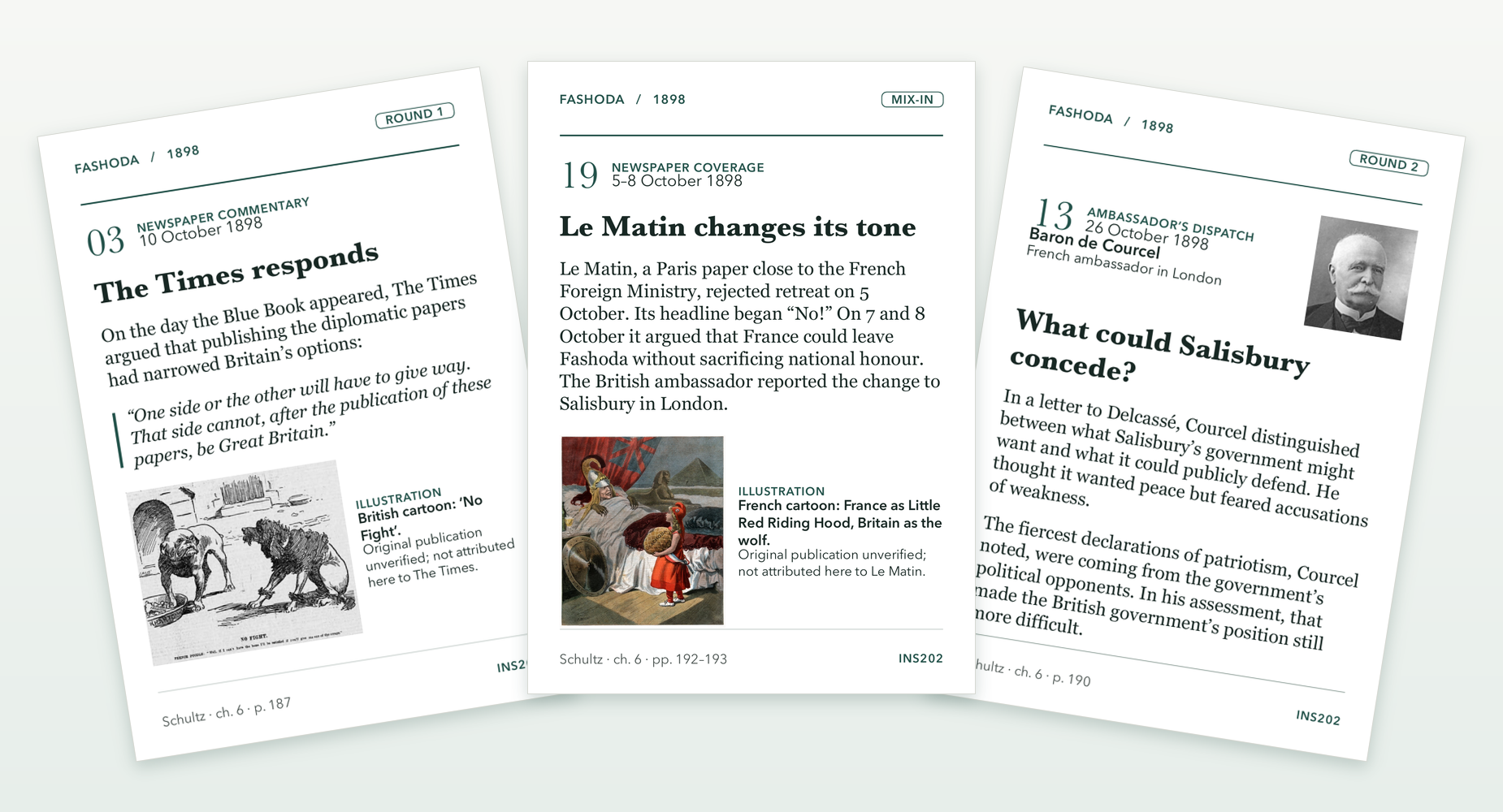
I use this puzzle to teach process tracing in my undergraduate International Relations Research Methods module. Following Kenneth A. Schultz’s Democracy and Coercive Diplomacy (2001, chapter 6), the seminar examines realist and democratic peace explanations alongside Schultz’s account of credible signalling. David Collier’s “Understanding Process Tracing” (2011) provides the method, applying sequential and counter-factual reasoning.
Groups begin with five background cards. Before seeing the evidence, they sketch a rough, testable causal mechanism for each explanation: A realist account might turn on French ministers taking the prospect of military defeat more seriously once Britain mobilised its fleet. A democratic peace account might emphasise how public opposition makes war politically costly. Schultz suggests a different role for public accountability: British opposition politicians backed the government’s hard line, making compromise, rather than war, politically costly.
The evidence comes in two rounds: first what happened in Britain, then what French officials reported and decided. The printed evidence cards give students something to gather around: they can lay out a sequence on the table, point to the exact wording on a disputed card, or move it from one causal chain to another. Releasing the French correspondence separately gives the group a reason to commit to a prediction before reading the answer back into the evidence. Each card cites the relevant page in Schultz so that students can check what the excerpt leaves out.
Students assess the cards using the four tests presented by Collier: straw-in-the-wind, hoop, smoking-gun, and doubly decisive. The task is not to find one of each, but to ask a counterfactual question about a particular link, deductively testing the hypotheses developed earlier.
Seminar materials: Download the printable evidence cards (PDF)
References
Collier, D. (2011). Understanding process tracing. PS: Political Science & Politics, 44(4), 823–830. https://doi.org/10.1017/S1049096511001429
Schultz, K. A. (2001). Democracy and coercive diplomacy. Cambridge University Press. https://doi.org/10.1017/CBO9780511491658